Services
PT Slab In Buildings
BnG offers PT Technology with vast experience in design and Execution of Post tensioning – Bonded and Un bonded works in buildings.
Now days extensive use of this technology is due to its demand and advantages to wide variety of structure geometry and economical design solutions and speed of construction.
Prestressing
Pre-Tension
Pre-Tension simply means that the steel is stressed (pulled or tensioned) before the concrete has to support the service loads. Most precast, pre-stressed concrete is actually pre-tensioned-the steel is pulled before the concrete is poured. Post-tensioned concrete means that the concrete is poured and then the tension is applied-but it is still stressed before the loads are applied so it is still pre-stressed.
Post– Tension
The principle is easily observed when holding together several books by pressing them laterally. Under such pressure the whole row gains enough stiffness and strength to ensure its integrity.
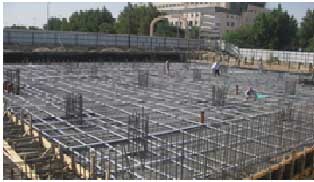
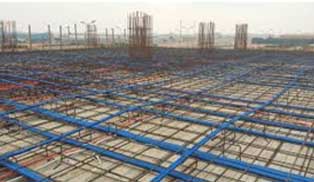
In concrete structures, this is achieved by placing high tensile steel tendons/cables in the element before casting. When the concrete reaches the desired strength, the tendons are pulled by special hydraulic jacks and held in tension using specially designed anchorages fixed at each end of the tendon.
This provides compression at the edge of the structural member that increases the strength of the concrete for resisting tension stresses.If tendons are appropriately curved to a certain profile, they will exert, in addition to compression at the perimeter, a beneficial upward set of forces (load balancing forces) that will counteract applied loads, relieving the structure from a portion of gravity effects.
Un bonded System - (Click to View)
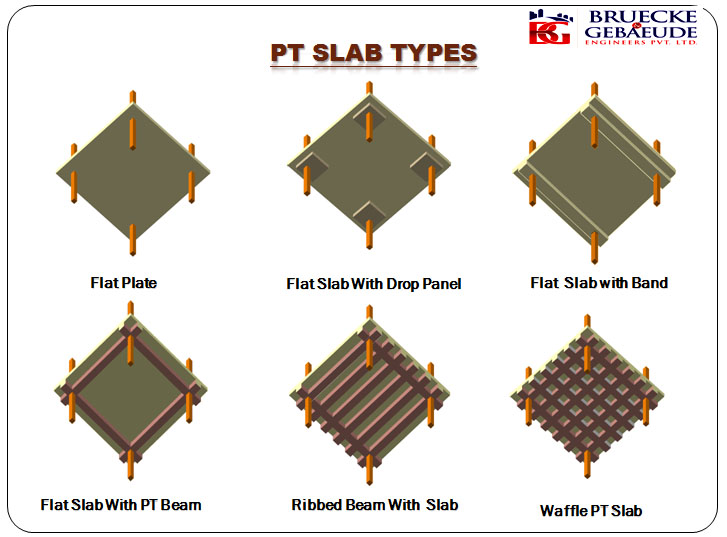
Pre stressed Concrete is preferred in Commercial , Industrial and Residential Floor Slab / Beam Constructions.
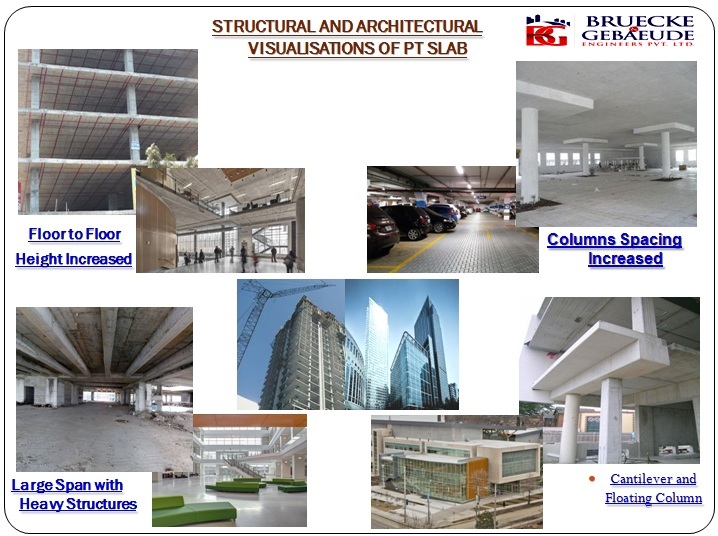
- Thinner Slabs, increased clear spans, increased headroom, Height of Building, faster shuttering and de-shuttering.
- Thin slabs that increase planned clearance under ceilings or reduce total building height
-Minimized deflections compared to structural members with reinforced concrete.
-Good crack behavior and therefore better protection of the steel against corrosion
-Greater Architectural/Structural freedom in design of slab shapes and positioning of columns
-High fatigue strength since the amplitude of stress changes in pre-stressing steel under alternating loads are quite small.
-Reduced Seismic Forces and Overturning Moments
Applications of Post Tensioning slabs / beams in multistory building:
-Suspended slabs like floor slabs and terrace slabs-Slab on Grade / Foundation slabs
-Cantilevers-Overhanging parts of building
-Facade elements of large area
-Podium slabs and parking slabs
-Major beams in the form of transfer girders, floating column loads on beams etc.